

The National Graphene Institute leads global 2D materials research, building on The University of Manchester’s legacy as the birthplace of graphene. We provide a uniquely integrated environment in which leading academics, industry partners and research institutions collaborate to advance the fundamental science and applied potential of atomically thin materials.
Our research spans the full spectrum. It is this combination of scientific rigour and translational ambition that defines the NGI's contribution to the field.
Research themes
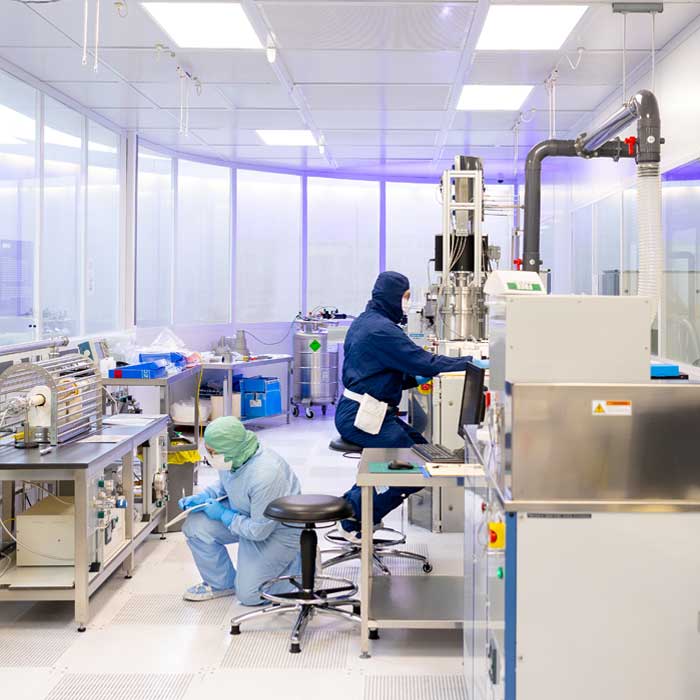
Our thematic approach captures the full breadth of 2D materials science, organised across a number of themes that cover everything from fundamental quantum physics to real-world applications in energy, medicine, and advanced materials.
These themes are intentionally interconnected, supporting a cross‑disciplinary environment where ideas develop efficiently from concept to impact.
2D materials microscopy
AFM and STM imaging
Theme lead: Dr Laura Fumagalli
- surface and sub-surface mapping and mechanical analysis: Using atomic force microscopy (AFM) to reveal topographic structures and their mechanics with submicron to atomic resolution.
- electrical property analysis: Measuring local conductivity and surface potential to study electrical behaviour of materials at the nanoscale.
- dielectric property analysis: Measuring local dielectric response to study electric polarization behaviour of materials at the nanoscale.
- atomic-scale imaging: Applying scanning tunnelling microscopy (STM) and AFM to characterise surfaces structure and electronic properties with atomic precision.

Multiscale modelling and theory of moire materials
Theme lead: Professor Vladimir Falko and Dr James McHugh
- atomic-level simulations: Using DFT and molecular dynamics to study structure, band alignment and defect behaviour in 2D materials.
- electronic models for complex systems: Building Hamiltonians to describe multilayers and twisted heterostructures using field theory and tight-binding approaches.
- device-level transport predictions: Simulating electrical, thermal, and optical performance in transistors, LEDs and THz devices.

Atomic structure of 2D material heterostructures
Theme lead: Professor Sarah Haigh and Dr Nick Clark
- atomic structure mapping: Using high-resolution STEM imaging to analyse atomic structure, defects, and layer alignment in 2D heterostructures, with automated data collection for large-area studies.
- high spatial resolution bonding and electronic structure analysis: Applying electron beam spectroscopy (EDX and EELS) to identify composition, bonding, and electronic structure at atomic scale.
- strain and lattice reconstruction: Using 4D-STEM and ptychography to map strain, electric fields, and atomic structure across moiré superlattices and layered materials.
- dynamics of atoms and ions at 2D surfaces and interfaces: Studying how atomic species move and interact at 2D material surfaces and interfaces using environmental imaging approaches.
- in-situ imaging and manipulation: Tracking structural and chemical changes in 2D heterostructures during heating, electrical biasing, and material processing in real time.

Advanced materials and composites
Composites
Theme lead: Professor Ian Kinloch
- enhanced strength and flexibility: Leveraging the unique properties of 2D materials to improve the mechanical strength and flexibility of composites and coatings.
- lightweight conductivity: Exploring how 2D materials can be used to produce lightweight materials that maintain or enhance electrical conductivity.
- durable protective coatings: Researching 2D materials for high-performance coatings with applications in corrosion resistance and wear protection.

Advanced nanomaterials
Theme lead: Professor Aravind Vijayaraghavan
- functional nanocomposites: Designing graphene enhanced thermoset and thermoplastic polymers, elastomers, foams and biopolymers for use in multifunctional applications such as structural, sensors, filtration, insulation and more.
- miniaturised sensing platforms: Developing MEMS and NEMS devices that detect changes in pressure, temperature or chemicals at the micro and nano scale.
- structure–property relationships: Investigating how nanoscale structuring affects the mechanical, electrical and thermal behaviour of advanced materials.

Assembly of 2D materials heterostructures
Theme lead: Professor Roman Gorbachev
- ultra-clean assembly of 2D heterostructures: Designing robotic systems to assemble atomically thin crystals in UHV or inert conditions for optoelectronic devices and quantum technologies.
- structural and opto-electronic studies of twistronic 2DM structures: Characterisation with scanning probe and transmission electron microscopies, cryogenic magneto-transport and optical techniques.
- atomic chemistry in liquids: Confining small volumes of liquids between 2D crystals and studying their chemical reactions with atomic resolution electron microscopy.

Advanced physical chemistry of vdW materials
Ion intercalation in van der Waals materials
Theme lead: Professor Irina Grigorieva
- quantum phase engineering: using ion intercalation to control superconducting and magnetic states in layered materials, supporting the development of tunable quantum systems and electronic devices.
- rechargeable energy storage materials: designing van der Waals crystals for use in next-generation battery electrodes with improved charge storage and cycling performance.
- ion transport at material interfaces: studying ion movement across van der Waals heterostructures to improve solid-state batteries, ion transport systems, and energy conversion technologies.
- coupled ion and electron transport: exploring how ionic and electronic behaviour interact in layered materials under external stimuli, supporting the development of responsive electronic and energy devices.

Electronics and quantum technologies
Adaptive THz technologies
Theme lead: Professor Coskun Kocabas
- development of adaptive optical materials: Modifying the optical response of 2D materials through electrostatic control and dynamic intercalation.
- THz and infrared imaging: Analysing composite materials at the nanoscale using advanced NanoIR and SNOM systems.
- applications in sensing and communications: Understanding the development of responsive materials for next-generation THz and infrared technologies.

Biocompatible 2D material Inks for printed electronics
Theme lead: Professor Cinzia Casiraghi
- printed electronics: Developing water-based graphene and other 2D material inks suitable for printed electronics – fully printed sensors, transistors, memristors, diodes onto rigid or flexible surfaces (e.g. paper).
- biomedical applications: Working with biocompatible graphene and other 2D material inks suitable for biomedical applications (e.g. imaging, drug delivery, etc).
- spectroscopic characterisation of 2D materials: Applying Raman spectroscopy to assess quality and properties of 2D materials.

Spintronics with 2D materials
Theme lead: Professor Thomas Thomson and Dr Ivan Vera-Marun
- spin transport in 2D systems: Investigating spin-dependent effects in 2D materials and their heterostructures for potential spintronic applications.
- magnetic materials research: Studying 2D and layered materials for use in magnetic memory and sensor technologies.
- thin film characterisation: Applying X-ray diffraction, reflection and electron microscopy techniques to analyse structure and morphology.

2D superconductors
Theme lead: Professor Irina Grigorieva
- exploring superconductivity in 2D systems: Atomically thin superconductors and topological phenomena in the superconducting state.
- electrochemical tuning of properties: Using lithium and other metal ions to modify the electronic behaviour of 2D materials and induce superconducting states.
- fundamental materials discovery: Investigating how reduced dimensionality influences the mechanisms of superconductivity and phase transitions.

Quantum physics of moiré materials
Theme lead: Professor Sir Andre Geim and Professor Vladimir Falko
- moiré material design and fabrication: developing graphene and hexagonal boron nitride (hBN) superlattices, including twisted graphene structures, to study new electronic and quantum behaviours.
- quantum transport in graphene devices: building graphene-based systems with ultra-high electronic mobility to investigate quantum transport phenomena, including quantum Hall effects and strongly correlated electronic states.
- non-equilibrium transport in 2D materials: exploring how electrons behave in 2D materials and heterostructures under extreme operating conditions and non-equilibrium regimes.

Energy and sustainability
2D materials for energy storage
Theme lead: Professor Mark Bissett
- high-capacity energy storage: Exploring how 2D materials can be utilised to improve batteries and supercapacitors to support higher capacity and longer cycle lifetimes.
- ultra-fast charging: Investigating how graphene and similar nanomaterials can reduce energy loss during charging of vehicles, devices and grid systems.
- energy harvesting: Using 2D materials in solar and thermoelectric devices to capture and convert energy more efficiently.

2D materials for green hydrogen
Theme lead: Professor Marcelo Lozada-Hidalgo
- catalysis for clean hydrogen: Investigating proton and molecular reactions in 2D materials to support hydrogen generation and use as a clean energy carrier.
- hydrogen separation and storage: Exploring how 2D membranes transport and trap protons for efficient hydrogen production, purification and storage.
- fuel cell membranes: Using 2D materials to improve proton exchange membranes, supporting more durable and efficient hydrogen fuel cells for energy and transport applications.

Heat management and thermoelectrics
Theme lead: Dr Andrey Kretinin
- flexible laminates: Developing laminates of various 2D materials for thermal management, electromagnetic shielding, sensors and waste heat utilisation, mainly focussing on mobile device and wearable electronics applications.
- thermal and thermoelectric transport in 2D materials: Studying the fundamentals of heat transport and thermoelectric properties of 2D materials in search of novel materials and approaches for efficient active and passive cooling, waste heat harvesting and thermal measurements.
- electronic transport in 2D materials and devices: Exploring electronic properties of van der Waals heterostructures and next-generation electronic devices built using these heterostructures.

Functional membranes
Theme lead: Professor Rahul Nair
- fundamental ionic and molecular transport: Investigating the permeation of water, ions and other molecules through 2D capillaries and membranes to advance understanding of nanoscale transport.
- water filtration: Developing advanced membranes using 2D materials and processes for efficient water purification and desalination applications.
- gas and liquid separation: Employing 2D material-based membranes for highly selective separation of gases and liquids, vital for industries such as chemical manufacturing, pharmaceutical production and food and beverage processing.
- membranes for clean energy: Designing novel membranes for hydrogen technologies and other emerging clean energy systems.
- energy-efficient membranes and processes: Creating high-performance membranes and optimising separation processes for lower energy consumption in challenging industrial applications, while supporting the development of more sustainable products and systems.

Health and biomedical applications
Safe and sustainable 2D materials
Theme lead: Dr Cyrill Bussy
- health and environmental safety: assessing how 2D materials and their composites interact with humans and ecosystems to support safe development, handling, and commercial use.
- biocompatibility for healthcare applications: developing tailored testing approaches to evaluate the biocompatibility of advanced 2D materials for diagnostics, therapeutics, and biomedical devices.
- regulation and standards: working with organisations including the Health and Safety Executive and Organisation for Economic Co-operation and Development (OECD) to support evidence-based policies, safety frameworks, and international standards for 2D materials.

Biocompatible 2D material Inks for printed electronics
Theme lead: Professor Cinzia Casiraghi
- printed electronics: Developing water-based graphene and other 2D material inks suitable for printed electronics – fully printed sensors, transistors, memristors, diodes onto rigid or flexible surfaces (e.g. paper).
- biomedical applications: Working with biocompatible graphene and other 2D material inks suitable for biomedical applications (e.g. imaging, drug delivery, etc).
- spectroscopic characterisation of 2D materials: Applying Raman spectroscopy to assess quality and properties of 2D materials.
Research publications
Explore publications from NGI researchers, covering graphene and advanced two‑dimensional materials across a wide range of applications.
Discover how to access our specialist facilities, tap into our leading expertise and create a partnerships designed to accelerate your research and development.
